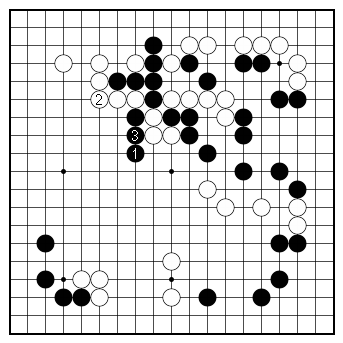
 Dia. 1 |
Dia. 1. Jumping ahead Black should jump ahead of the three white stones to the right, threatening to engulf them. Black 1 is much like casting a net ahead of a prey to snare it. Suppose White defends his weak point by connecting at 2. Black would then connect at 3 and there is no escape for the three white stones. For example — |
 Dia. 2 |
Dia. 2. The one-space jump 1 If White jumps to 1, White captures with 2 and 4, rescuing his six stones at the top. |
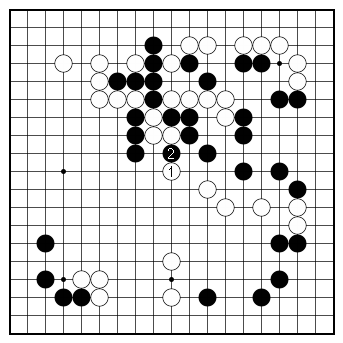 Dia. 3 |
Dia. 3. The one-space jump 2 If White jumps to 1 here, Black 2 captures three stones, again rescuing his stones at the top. |
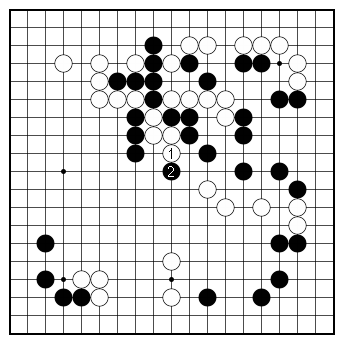 Dia. 4 |
Dia. 4. Turning Turning with White 1 also fails. After Black plays the nose-attachment tesuji of 2, White has no good response. |
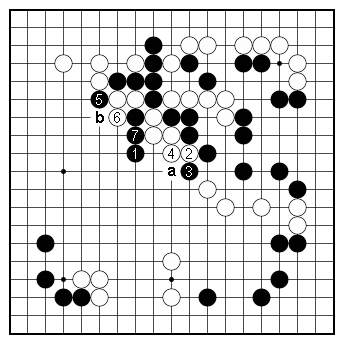 Dia. 5 |
Dia. 5. Two options After Black 1, instead of 2 in Dia. 1, counterattacking with the hane of White 2 fails. Black ataries at 3, and then at 5. If White ataries at 6, Black connects at 7. He is now threatening to capture five stones at 'a' or three stones in a ladder at 'b'. |
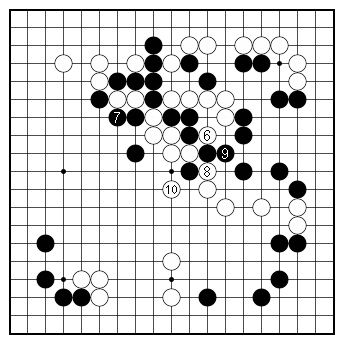 Dia. 6 |
Dia. 6. Black escapes. Instead of 6 in Dia. 5, White might choose to capture three stones by cutting at 6. Black would then capture two stones with 7 and his stones at the top have escaped. Finally, White secures his thin group on the right side with 8 and 10. |
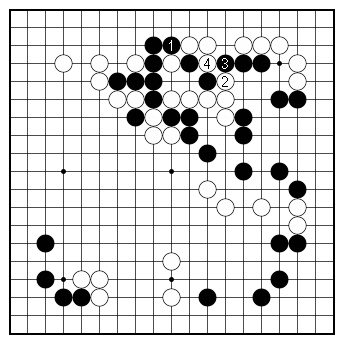 Dia. 7 |
Dia. 7. Trying to link up Black might try to link up with his group on the right, but this ends in failure after White 4. |
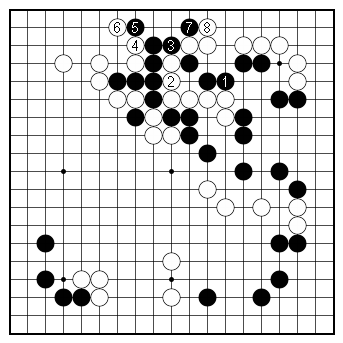 Dia. 8 |
Dia. 8. Behind by one move Black 1 is another way that Black might try to link up. After Black cuts with 3, White blocks at 4 and a capturing race begins. Black tries to make eyes with 5 and 7, but he is still one move behind in the capturing race. |
|
Recommended reading and a note on terminolgy The tesuji of Black 1 in Dia. 1 is referred to as kake in Japanese, which means 'pressing' or 'covering'. However, in the way it is used in this example, I prefer the phrase 'cast a net'. Another Japanese term for this kind of move is geta, which I used in the first article of Go World Online. You can find a glossary of Japanese go terms in The Go Player's Almanac 2001. This glossary is also available as an eBook. See Dictionary of Go Terms. You can also find an example and a number of problems for this tesuji in A Survey of the Basic Tesujis, from pages 161 to 167. |