 Dia. 1 |
Dia. 1. A magical move The extension of White 1 is an almost magical move. The follow-ups are very difficult to read out. Next — |
 Dia. 2 |
Dia. 2. Hard to read out Black ataries with 2 and White captures the ko with 3. Escaping the ladder with 4 is not a very good threat because every move made to escape a ladder that fails loses about seven points. However, it is the only threat Black has in this position. The next white moves are brilliant, but are hard to read out, especially starting from White 1 in Dia. 1. |
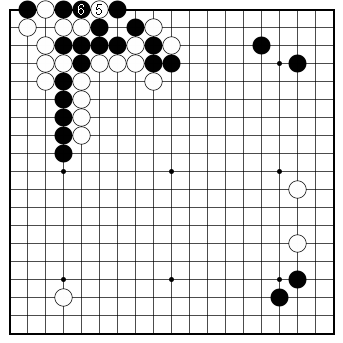 Dia. 3 |
Dia. 3. Sacrifice and capture Throwing in a stone with 5 is the key move. Since it is an atari, Black must capture it with 6. Note that Black can't connect because he would still be in atari. Next — |
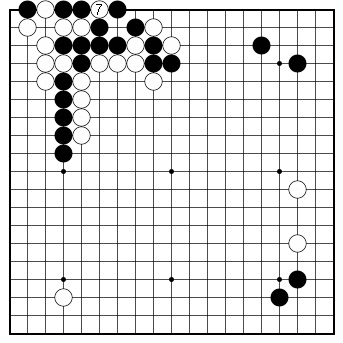 Dia. 4 |
Dia. 4. Recapture White now captures two stones with 7. Next — |
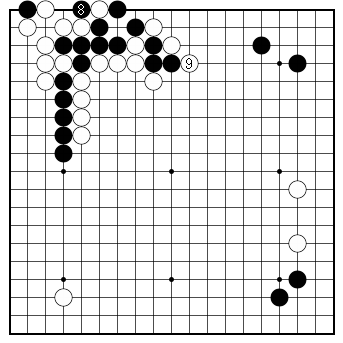 Dia. 5 |
Dia. 5. Black's stones are captured. Again Black is in atari, so he must capture with 8. But lo and behold, the ko has been resolved. White now captures three stones in a ladder with 9, along with all of Black's other stones in the top left. |
 Dia. 6 |
Dia. 6. Failure Suppose White is unable to read out the moves in Dias. 1 to 5. Since White doesn't have any ko threats, he will probably give up on the ko and simply make life in the corner with the moves from 1 to 5. After Black 6, the sequence comes to a pause with an even result. So why is this diagram a failure for White? Compare the result of this diagram with that of Dia. 5; the difference is stunning. |
|
Recommended reading Fighting a ko is the most difficult part of go to master. The book I recommend to help you out is All About Ko. The main feature of this book is that it lays out the basic concepts of ko in 20 short chapters, most of which are easily accessible to kyu-level players. The book ends with 122 problems that start with very easy ones and gradually progress to difficult ones. Some of the highlights of this book are three chapters containing Segoe Kensaku's classic analyses of 'Bent Four in the Corner', 'The Ten-Thousand-Year Ko', and 'Double and Triple Kos'. |