 Dia. 1. Correct |
Dia. 1. Atekomi Wedging in at the vertex of the two marked diagonally placed stones is again the tesuji. |
 Dia. 2 |
Dia. 2. White is captured. If White connects at 2, Black ataries with 3 and jumps ahead of the now isolated three white stones with 5. White can't escape, so Black has extricated his endangered stones. |
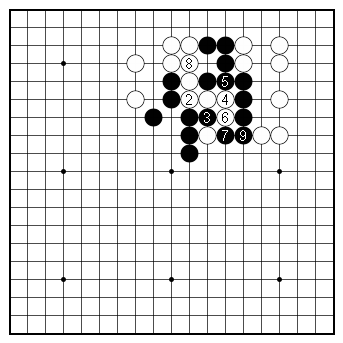 Dia. 3 |
Dia. 3. Variation In answer to Black 1 in Dia. 1, White might try connecting at 2. Black would force with the moves to 7, then connect at 9. Black's stones have escaped. |
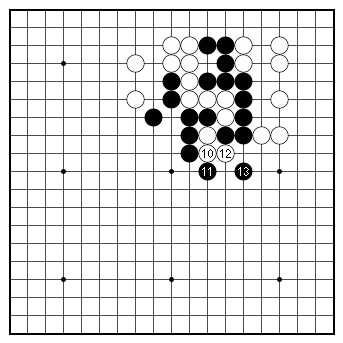 Dia. 4 |
Dia. 4. If a ladder is favorable If there is a ladder in White's favor, he might try to escape with 10 and 12. However, Black has another tesuji up his sleeve: the geta of 13. . |
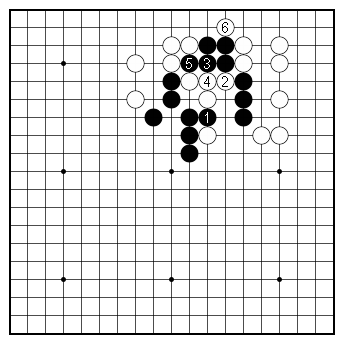 Dia. 5 |
Dia. 5. Black's failure If Black pushes in with 1, White will cut at 2, trapping the three white stones at the top. Black starts a capturing race with 3 and 5, but he has no good answer to White's atari at 6. |
|
Recommended reading For the novice player who aspires to reach dan-level strength, the best book for studying tesujis is A Survey of the Basic Tesujis. It presents 38 tesujis, each one introduced with a simple example, followed by a number of straightforward, uncomplicated, kyu-level problems. Of course the atekomi tesuji is included, with one example followed by six problems. If you are a kyu-level player, diligent study of this book will increase your fighting strength in the middle game by two or more handicap stones. |