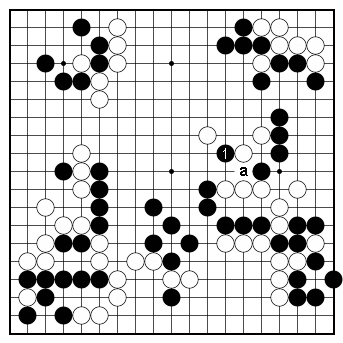
 Dia. 1 |
Dia. 1. The attachment tesuji The attachment of Black 1 is the tesuji. Black is threatening to cut off the six white stones on the right side by playing at 'a'. |
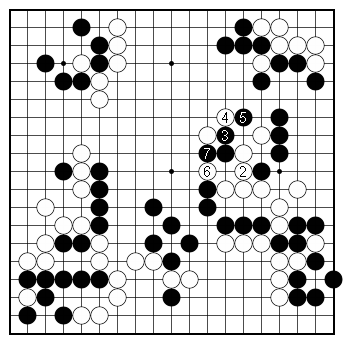 Dia. 2 |
Dia. 2. White connects. If White connects at 2, Black pushes at 3, then hanes at 5. White fights back with the hane of 6, but, after Black 7, White's stones on the right side are trapped. |
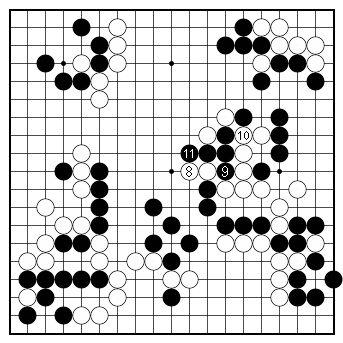 Dia. 3 |
Dia. 3. Black escapes. White might extend to 8. In that case, Black cuts at 9, White cuts at 10, and Black extends to 11. Again, White's stones on the right are trapped and White's stones in the center are too thin to capture the black stones there. |
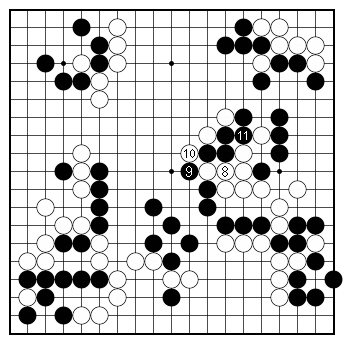 Dia. 4 |
Dia. 4. Black's groups are thick Instead of 8 in Dia. 3, White might connect at 8. Black would then block at 9. Next, White ataries with 10, but, after Black connects at 11, his postions are too thick for White to do any damage. In the meantime, White's group on the right side is trapped. |
 Dia. 5 |
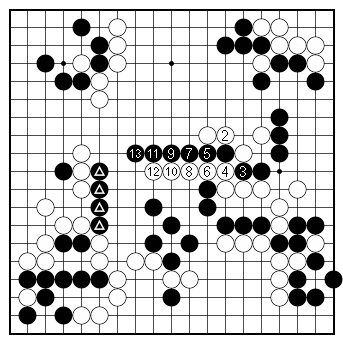
Dia. 5. Nowhere to make eyes Instead of 2 in Dia. 2, what happens if White blocks with 2? Of course, Black will cut at 3. Next, White tries to pull his group out with 4 on, but the moves to 12 prove to be futile. The thick marked black stones deny White any chance to escape or to make eyes. |
 Dia. 6 |
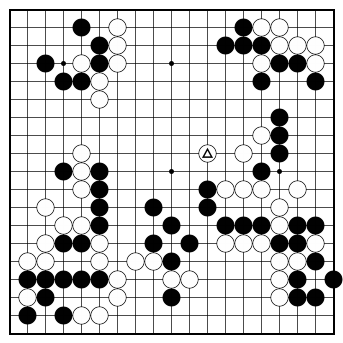
Dia. 6. The shape move Instead of the marked stone in the problem diagram, the one-space jump with the marked stone in this diagram would be the shape move. White's stones still do not have two eyes but at least they have more flexibility than before. |
|
Recommended reading Managing thin groups, as well as weak groups, whether attacking them or defending them, is essentially about shape, sabaki, and finding the right tesuji to exploit or defend a weakness in that group. You can find many examples and problems pertaining to such groups in Making Good Shape, Sabaki – The Art of Settling Stones, and Attacking and Defending Weak Groups. |